



 Germany
 Japan
Japan
 United Kingdom
 China
China
Human KIR2DL2 activation kit by CRISPRa
CAT#: GA102574
KIR2DL2 CRISPRa kit - CRISPR gene activation of human killer cell immunoglobulin like receptor, two Ig domains and long cytoplasmic tail 2
Find the corresponding CRISPRi Inhibitor Kit
USD 1,290.00
2 Weeks*
Product Images
Specifications
| Product Data | |
| Format | 3gRNAs, 1 scramble ctrl and 1 enhancer vector |
| Symbol | KIR2DL2 |
| Locus ID | 3803 |
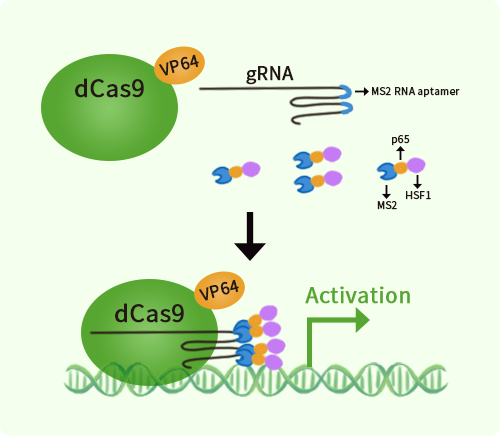
| Kit Components | GA102574G1, KIR2DL2 gRNA vector 1 in pCas-Guide-GFP-CRISPRa GA102574G2, KIR2DL2 gRNA vector 2 in pCas-Guide-GFP-CRISPRa GA102574G3, KIR2DL2 gRNA vector 3 in pCas-Guide-GFP-CRISPRa 1 CRISPRa-Enhancer vector, SKU GE100056 1 CRISPRa scramble vector, SKU GE100077 |
| Disclaimer | The kit is designed based on the best knowledge of CRISPa SAM technology. The efficiency of the activation can be affected by many factors, including nucleosome occupancy status, chromatin structure and the gene expression level of the target, etc. |
| Reference Data | |
| RefSeq | NM_014219 |
| Synonyms | CD158b; CD158B1; NKAT-6; NKAT6; p58.2 |
| Summary | 'Killer cell immunoglobulin-like receptors (KIRs) are transmembrane glycoproteins expressed by natural killer cells and subsets of T cells. The KIR genes are polymorphic and highly homologous and they are found in a cluster on chromosome 19q13.4 within the 1 Mb leukocyte receptor complex (LRC). The gene content of the KIR gene cluster varies among haplotypes, although several "framework" genes are found in all haplotypes (KIR3DL3, KIR3DP1, KIR3DL4, KIR3DL2). The KIR proteins are classified by the number of extracellular immunoglobulin domains (2D or 3D) and by whether they have a long (L) or short (S) cytoplasmic domain. KIR proteins with the long cytoplasmic domain transduce inhibitory signals upon ligand binding via an immune tyrosine-based inhibitory motif (ITIM), while KIR proteins with the short cytoplasmic domain lack the ITIM motif and instead associate with the TYRO protein tyrosine kinase binding protein to transduce activating signals. The ligands for several KIR proteins are subsets of HLA class I molecules; thus, KIR proteins are thought to play an important role in regulation of the immune response. [provided by RefSeq, Jul 2008]' |
Documents
| Product Manuals |
| FAQs |
Resources
Other Versions
| SKU | Description | Size | Price |
|---|---|---|---|
| KN424797 | KIR2DL2 - KN2.0, Human gene knockout kit via CRISPR, non-homology mediated. |
USD 1,290.00 |
{0} Product Review(s)
Be the first one to submit a review