



 Germany
 Japan
Japan
 United Kingdom
 China
China
Ikaros (IKZF1) (NM_006060) Human Mass Spec Standard
CAT#: PH313207
IKZF1 MS Standard C13 and N15-labeled recombinant protein (NP_006051)
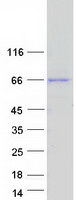
Product Images
Specifications
| Product Data | |
| Tag | C-Myc/DDK |
| Species | Human |
| Expression Host | HEK293 |
| Expression cDNA Clone or AA Sequence | RC213207 |
| Predicted MW | 57.3 kDa |
| Protein Sequence |
>RC213207 representing NM_006060
Red=Cloning site Green=Tags(s) MDADEGQDMSQVSGKESPPVSDTPDEGDEPMPIPEDLSTTSGGQQSSKSDRVVASNVKVETQSDEENGRA CEMNGEECAEDLRMLDASGEKMNGSHRDQGSSALSGVGGIRLPNGKLKCDICGIICIGPNVLMVHKRSHT GERPFQCNQCGASFTQKGNLLRHIKLHSGEKPFKCHLCNYACRRRDALTGHLRTHSVGKPHKCGYCGRSY KQRSSLEEHKERCHNYLESMGLPGTLYPVIKEETNHSEMAEDLCKIGSERSLVLDRLASNVAKRKSSMPQ KFLGDKGLSDTPYDSSASYEKENEMMKSHVMDQAINNAINYLGAESLRPLVQTPPGGSEVVPVISPMYQL HKPLAEGTPRSNHSAQDSAVENLLLLSKAKLVPSEREASPSNSCQDSTDTESNNEEQRSGLIYLTNHIAP HARNGLSLKEEHRAYDLLRAASENSQDALRVVSTSGEQMKVYKCEHCRVLFLDHVMYTIHMGCHGFRDPF ECNMCGYHSQDRYEFSSHITRGEHRFHMS TRTRPLEQKLISEEDLAANDILDYKDDDDKV |
| Purity | > 80% as determined by SDS-PAGE and Coomassie blue staining |
| Concentration | 50 ug/ml as determined by BCA |
| Labeling Method | Labeled with [U- 13C6, 15N4]-L-Arginine and [U- 13C6, 15N2]-L-Lysine |
| Buffer | 100 mM glycine, 25 mM Tris-HCl, pH 7.3. Store at -80°C. Avoid repeated freeze-thaw cycles. Stable for 3 months from receipt of products under proper storage and handling conditions. |
| Reference Data | |
| RefSeq | NP_006051 |
| RefSeq Size | 3962 |
| RefSeq ORF | 1557 |
| Synonyms | CVID13; Hs.54452; IK1; IKAROS; LyF-1; LYF1; PPP1R92; PRO0758; ZNFN1A1 |
| Locus ID | 10320 |
| UniProt ID | Q13422, R9R4D9 |
| Cytogenetics | 7p12.2 |
| Summary | This gene encodes a transcription factor that belongs to the family of zinc-finger DNA-binding proteins associated with chromatin remodeling. The expression of this protein is restricted to the fetal and adult hemo-lymphopoietic system, and it functions as a regulator of lymphocyte differentiation. Several alternatively spliced transcript variants encoding different isoforms have been described for this gene. Most isoforms share a common C-terminal domain, which contains two zinc finger motifs that are required for hetero- or homo-dimerization, and for interactions with other proteins. The isoforms, however, differ in the number of N-terminal zinc finger motifs that bind DNA and in nuclear localization signal presence, resulting in members with and without DNA-binding properties. Only a few isoforms contain the requisite three or more N-terminal zinc motifs that confer high affinity binding to a specific core DNA sequence element in the promoters of target genes. The non-DNA-binding isoforms are largely found in the cytoplasm, and are thought to function as dominant-negative factors. Overexpression of some dominant-negative isoforms have been associated with B-cell malignancies, such as acute lymphoblastic leukemia (ALL). [provided by RefSeq, May 2014] |
| Protein Families | Druggable Genome, Transcription Factors |
Documents
| FAQs |
Resources
Recombinant Protein Resources |
Other Versions
| SKU | Description | Size | Price |
|---|---|---|---|
| LC416893 | IKZF1 HEK293T cell transient overexpression lysate (as WB positive control) |
USD 187.00 |
|
| LY416893 | Transient overexpression lysate of IKAROS family zinc finger 1 (Ikaros) (IKZF1) |
USD 665.00 |
|
| TP313207 | Recombinant protein of human IKAROS family zinc finger 1 (Ikaros) (IKZF1) |
USD 788.00 |
{0} Product Review(s)
Be the first one to submit a review