



 Germany
 Japan
Japan
 United Kingdom
 China
China
p21 (CDKN1A) Mouse Monoclonal Antibody [Clone ID: DCS-60]
Product Images
Other products for "CDKN1A"
Specifications
| Product Data | |
| Clone Name | DCS-60 |
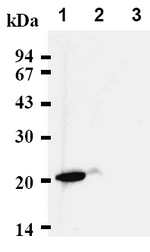
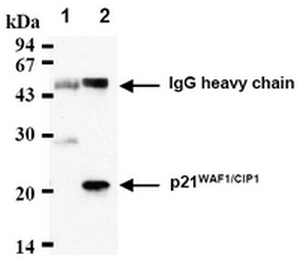
| Applications | IHC, IP, WB |
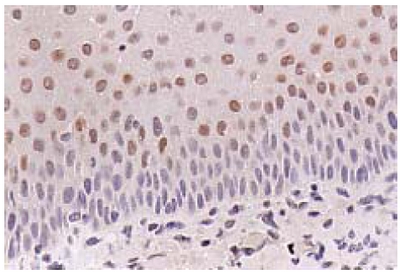
| Recommended Dilution | Western Blot: 1-5 µg/mL Positive Control: HeLa Cells. Immunoprecipitation: 3 µg/200-300 µL of cell extract. Positive Control: HeLa Cells. Immunohistochemistry: 1-5 μg/mL Heat treatment is necessary for Paraffin Embedded Sections. Microwave oven: 2 times for 10 minutes each in citrate buffer (pH 6.5). Positive Controls: Tonsil Tissue. Detailed procedure is provided in Protocols. |
| Reactivities | Human |
| Host | Mouse |
| Isotype | IgG2a |
| Clonality | Monoclonal |
| Immunogen | Full-length Recombinant Human p21WAF1/CIP1. |
| Specificity | This antibody reacts with Human p21WAF1/CIP1. |
| Formulation | PBS, pH 7.2 containing 50% Glycerol without preservatives. State: Azide Free State: Liquid purified IgG fraction. |
| Concentration | lot specific |
| Purification | Protein-A Sepharose Chromatography. |
| Storage | Store the antibody undiluted at -20°C. |
| Stability | Shelf life: one year from despatch. |
| Gene Name | Homo sapiens cyclin dependent kinase inhibitor 1A (CDKN1A), transcript variant 1 |
| Database Link | |
| Background | p21WAF1/CIP1 is one member of the CIP/KIP family that controls the cell cycle by inhibiting cyclin dependent kinases (CDKs) activity. Increased expression of p21WAF1/CIP1 may play an important role in the growth arrest induced in transformed cells. It is reported that hypermethylation of the p21WAF1/CIP1 promoter region inactivate p21WAF1/CIP1 gene leading tumorigenesis, and also reported that p21WAF1/CIP1 acts as an inhibitor of apoptosis in a number of systems in addition to being an inhibitor of cell proliferation. |
| Synonyms | CAP20, CDKN1, CIP1, MDA6, MDA-6, PIC1, SDI1, WAF1 |
| Note | This product was originally produced by MBL International. Protocol: SDS-PAGE & Western Blotting 1) Wash the cells 3 times with PBS and suspend with 10 volume of cold Lysis buffer (50 mM Tris-HCl, pH 7.2, 250 mM NaCl, 0.1% NP-40, 2 mM EDTA, 10% glycerol) containing appropriate protease inhibitors. Incubate it at 4°C with rotating for 30 minutes, then sonicate briefly (up to 10 seconds). 2) Centrifuge the tube at 12,000 x g for 10 minutes at 4°C and transfer the supernatant to another tube. Measure the protein concentration of the supernatant and add the Lysis buffer to make 8 mg/mL solution. 3) Mix the sample with equal volume of Laemmli’s sample buffer. 4) Boil the samples for 2 minutes and centrifuge. Load 10 μL of the sample per lane in a 1 mm thick SDS-polyacrylamide gel for electrophoresis. 5) Blot the protein to a polyvinylidene difluoride (PVDF) membrane at 1 mA/cm2 for 1 hour in a semi-dry transfer system. (Transfer Buffer: 25 mM Tris, 190 mM glycine, 20% MeOH). See the manufacture's manual for the transfer procedure. 6) To reduce nonspecific binding, soak the membrane in 10% skimmed milk (in PBS, pH 7.2) for 1 hour at room temperature, or overnight at 4°C. 7) Incubate the membrane with the anti-p21WAF1/CIP1 (DCS-60) monoclonal antibody (1-5 μg/mL) diluted with 1% skimmed milk (in PBS, pH 7.2) for 1 hour at room temperature. 8) Wash the membrane with PBS (5 minutes x 6 times). 9) Incubate the membrane with the 1:10000 POD-conjugated anti-mouse IgG diluted with 1% skimmed milk (in PBS, pH 7.2) for 1 hour at room temperature. 10) Wash the membrane with PBS (5 minutes x 6 times). 11) Wipe excess buffer from the membrane, then incubate it with appropriate chemiluminescence reagents for 1 minute. Remove extra reagent from the membrane by dabbing with a paper towel, and seal it in plastic wrap. 12) Expose to an X-ray film in a dark room for 5 minutes. Develop the film as usual. The conditions for exposure and development may vary. Positive Control for Western blotting: HeLa. Immunoprecipitation 1) Wash the cells 3 times with PBS and suspend with 10 volume of cold Lysis buffer (50 mM Tris-HCl, pH 7.2, 250 mM NaCl, 0.1% NP-40, 2 mM EDTA, 10% glycerol) containing appropriate protease inhibitors. Incubate it at 4°C with rotating for 30 minutes, then sonicate briefly (up to 10 seconds). 2) Centrifuge the tube at 12,000 x g for 10 minutes at 4°C and transfer the supernatant to another tube. 3) Add 3 μg of the anti-p21WAF1/CIP1 (DCS-60) monoclonal antibody into 250 μL of the supernatant. Mix well and incubate with gentle agitation for 30-120 minutes at 4°C. Add 20 μL of 50% Protein A-agarose beads resuspended in the Lysis buffer. Mix well and incubate with gentle agitation for 60 minutes at 4°C. 4) Wash the beads 3-5 times with ice-cold Lysis buffer (centrifuge the tube at 2,500 x g for 10 seconds). 5) Resuspend the beads in 20 μL of Laemmli’s sample buffer, boil for 3-5 minutes, and centrifuge for 5 minutes. Use 10 μL/lane for the SDS-PAGE analysis. (See SDS-PAGE & Western blotting.) Positive Controls for immunoprecipitation: HeLa cells. Immunohistochemical Staining for Paraffin-Embedded Sections: SAB method 1) Deparaffinize the sections with Xylene 3 times for 3-5 minutes each. 2) Wash the slides with Ethanol 3 times for 3-5 minutes each. 3) Wash the slides with PBS 3 times for 3-5 minutes each. 4) Heat treatment Heat treatment by microwave oven: Place the slides put on staining basket in 500 mL beaker with 500 mL citrate buffer (pH 6.5). Cover the beaker with plastic wrap, then process the slides 2 times for 10 minutes each at 500 W with microwave oven. Let the slides cool down in the beaker at room temperature for about 40 minutes. 5) Remove the slides from the citrate buffer and cover each section with 3% H2O2 for 10 minutes at room temperature to block endogenous peroxidase activity. Wash 3 times in PBS for 5 minutes each. 6) Remove the slides from PBS, wipe gently around each section and cover tissues with Protein Blocking Agent for 5 minutes to block non-specific antibody staining. Do not wash. 7) Tip off the blocking buffer, wipe gently around each section and cover tissues with the anti-p21WAF1/CIP1 (DCS-60) monoclonal antibody diluted with PBS containing 1% BSA (1-5 µg/mL). 8) Incubate the sections for 1 hour at room temperature. 9) Wash the slides 3 times in PBS for 5 minutes each. 10) Wipe gently around each section and cover tissues with Polyvalent Biotinylated Antibody. Incubate for 10 minutes at room temperature. Wash as in step 9. 11) Wipe gently around each section and cover tissues with Streptavidin-Peroxidase. Incubate for 10 minutes at room temperature. Wash as in step 9. 12) Visualize by reacting for 10-20 minutes with substrate solution containing 7.5 mg DAB, 40 µL of 30% H2O2 in 150 mL PBS. *DAB is a suspected carcinogen and must be handled with care. Always wear gloves. 13) Wash the slides in water for 5 minutes. 14) Counter stain in hematoxylin for 1 minute, wash the slides 3 times in water for 5 minutes each, and then immerse the slides in PBS for 5 minutes. Dehydrate by immersing in Ethanol 3 times for 3 minutes each, followed by immersing in Xylene 3 times for 3 minutes each. 15) Now ready for mounting. Positive Control for Immunohistochemistry: Tonsil Tissue. |
| Reference Data | |
| Protein Families | Druggable Genome |
| Protein Pathways | Bladder cancer, Cell cycle, Chronic myeloid leukemia, ErbB signaling pathway, Glioma, Melanoma, p53 signaling pathway, Pathways in cancer, Prostate cancer |
Documents
| Product Manuals |
| FAQs |
{0} Product Review(s)
0 Product Review(s)
Submit review
Be the first one to submit a review



Product Citations
*Delivery time may vary from web posted schedule. Occasional delays may occur due to unforeseen
complexities in the preparation of your product. International customers may expect an additional 1-2 weeks
in shipping.