PD L1 (CD274) Mouse Monoclonal Antibody [Clone ID: 27A2]

CAT#: AM26531AF-N

PD L1 (CD274) mouse monoclonal antibody, clone 27A2, Azide Free


Size
    • 100 ug

Product Images

Specifications

Product Data
Clone Name 27A2
Applications FC, IHC
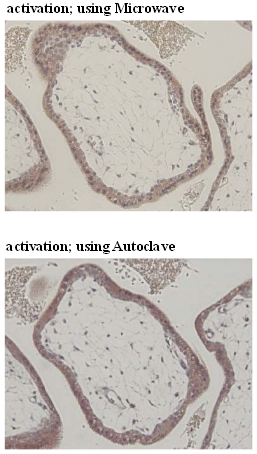
Recommended Dilution Immunohistochemistry on Paraffin Sections: 10 μg/ml. Heat treatment is necessary.
Microwave oven; 2 times for 15 minutes each in 10 mM citrate buffer (pH 6.0); Autoclave; 10 minutes at 120 °C in 10 mM citrate buffer (pH 6.0) * Recommended activation; Autoclave.
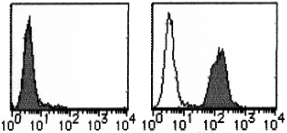
Flow Cytometry: 10 μg/ml (final concentration).
For details see Protocols below.
Reactivities Human
Host Mouse
Isotype IgG2b
Clonality Monoclonal
Immunogen Recombinant human PD-L1 extracellular domain
Specificity
This antibody reacts with Human CD274 antigen. Other species not tested.
Formulation PBS containing 50% glycerol, pH 7.2. No preservative is contained.
State: Azide Free
State: Liquid purified Ig fraction
Concentration 1.0 mg/ml
Purification Protein A agarose
Background Programmed death ligand 1 (PD-L1, also known as CD274/B7-H1), a member of B7 family was identified by searching for mo lecules that share homology with the immunogloblin V and C domains of B7-1 and B7-2 among the human cDNA expressed sequence tags in the National Center for Biotechnology Information database. PD-L1 is a ligand for programmed death 1 (PD-1) which belongs to the CD28/CTLA4 subfamily. Although in vitro study indicated that the cross-linking of PD-1 by PD-L1 leads to down-regulation of T-cell responses, some studies have shown that T cells stimulated with low levels of anti-CD3 and immobilized PD-L1-Ig were activated, proliferation and production of IFN- γ GM-CSF and IL-10 from the T cells were enhanced. The role of PD-L1 is now debatable.
Synonyms PD-L1, PDCD1 ligand 1, B7H1, B7H1, B7 homolog 1, PDCD1L1, PDCD1LG1
Note

This product was originally produced by MBL International.


Protocol:

Flow cytometric analysis for floating cells
We usually use Fisher tubes or equivalents as reaction tubes for all step described below.
1) Wash the cells 3 times with washing buffer [PBS containing 2% fetal calf serum (FCS) and 0.1% NaN3].
2) Resuspend the cells with washing buffer (5x10e6 cells/mL).
3) Add 50 µL of the cell suspension into each tube, and centrifuge at 500 x g for 1 minute at room temperature (20~25°C). Remove supernatant by careful aspiration.
4) Add 10 µL of normal goat serum containing 1 mg/mL normal human IgG and 0.1% NaN3 to the cell pellet after tapping. Mix well and incubate for 5 minutes at room temperature.
5) Add 40 µL of the primary antibody at the concentration of as suggest in the APPLICATIONS diluted with the washing buffer. Mix well and incubate for 30 minutes at room temperature.
6) Add 1 mL of the washing buffer followed by centrifugation at 500 x g for 1 minute at room temperature. Remove supernatant by careful aspiration.
7) Add 30 µL of 1:100 FITC conjugated anti-mouse IgG diluted with the washing buffer. Mix well and incubate for 15 minutes at room temperature.
8) Add 1 mL of the washing buffer followed by centrifugation at 500 x g for 1 minute at room temperature. Remove supernatant by careful aspiration.
9) Resuspend the cells with 500 µL of the washing buffer and analyze by a flow cytometer.

Immunohistochemical staining for paraffin-embedded sections: SAB method
1) Deparaffinize the sections with Xylene 3 times for 3-5 minutes each.
2) Wash the slides with Ethanol 3 times for 3-5 minutes each.
3) Wash the slides with PBS 3 times for 3-5 minutes each.
4) Heat treatment Heat treatment by Microwave: Place the slides put on staining basket in 500 mL beaker with 500 mL of 10 mM citrate buffer (pH 6.0). Cover the beaker with plastic wrap, then process the slides 2 times for 15 minutes each at 500 W with microwave oven. Let the slides cool down in the beaker at room temperature for about 40 minutes. Heat treatment by Autoclave: Place the slides put on staining basket in 500 mL beaker with 500 mL of 10 mM citrate buffer (pH 6.0). Cover the beaker with plastic wrap, then process the slides with the autoclave for 10 minutes at 120°C. Let the slides cool down in the beaker at room temperature for about 40 minutes.
5) Remove the slides from the citrate buffer and cover each section with 0.3% H2O2  in MeOH for 15 minutes at room temperature to block endogenous peroxidase activity. Wash 3 times in PBS for 5 minutes each.
6) Remove the slides from PB S, wipe gently around each section and cover tissues with Protein Blocking Agent for 30 minutes to block non-specific staining. Do not wash.
7) Tip off the blocking buffer, wipe gently around each section and cover tissues with primary antibody diluted with PBS containing 1% BSA as suggest in the APPLICATIONS .
8) Incubate the sections overnight at 4°C.
9) Wash the slides 3 times in PBS-T [0.05% Tween-20 in PBS] for 5 minutes each.
10) Wipe gently around each section and cover tissues with Polyvalent Biotinylated Antibody. Incubate for 30 minutes at room temperature. Wash as in step 9).
11) Wipe gently around each section and cover tissues with Streptavidin-Peroxidase. Incubate for 30 minutes at room temperature. Wash as in step 9).
12) Visualize by reacting for 30 minutes with substrate solution.
*DAB is a suspect carcinogen and must be handled with care. Always wear gloves.
13) Wash the slides in water for 5 minutes.
14) Counter stain in hematoxylin for 1 minute, wash the slides 3 times in water for 5 minutes each, and then immerse the slides in PBS for 5 minutes. Dehydrate by immersing in Ethanol 3 times for 3 minutes each, followed by immersing in Xylene 3 times for 3 minutes each.
15) Now ready for mounting.
(Positive control for Immuno histochemistry; placenta)

Reference Data

{0} Product Review(s)

0 Product Review(s) Submit review

Be the first one to submit a review

Product Citations

*Delivery time may vary from web posted schedule. Occasional delays may occur due to unforeseen complexities in the preparation of your product. International customers may expect an additional 1-2 weeks in shipping.