


 Germany
 Japan
Japan
 United Kingdom
 China
China
TRAF1 / EBI6 (1-410) Mouse Monoclonal Antibody [Clone ID: 3D4]
CAT#: AM26584AF-N
TRAF1 / EBI6 (1-410) mouse monoclonal antibody, clone 3D4, Azide Free
Product Images
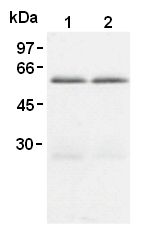
Specifications
| Product Data | |
| Clone Name | 3D4 |
| Applications | WB |
| Recommended Dilution | Western blot: 1 μg/ml for chemiluminescence detection system. |
| Reactivities | Mouse |
| Host | Mouse |
| Isotype | IgG1 |
| Clonality | Monoclonal |
| Immunogen | Recombinant full-length mouse TRAF1 (1-410 aa) |
| Specificity |
|
| Formulation | PBS containing 50% glycerol, pH 7.2. No preservative is contained. State: Azide Free State: Liquid Ig fraction |
| Concentration | 1.0 mg/ml |
| Purification | Protein A agarose |
| Background | Tumor necrosis factor receptor (TNF-R) superfamily such as TNFR1, TNFR2, CD30 and CD40-mediated signaling is provided by the TRAF (TNF receptor associated factors) family. The members of the TRAF family form either homodimers or heterodimers result in extensive diversity and specificity in their signal transduction pathways. TRAF1 and TRAF2 were found to associate with the cytoplas mic domains of the TNFR2. However, TRAF1 is indirec tly associated TNFR2 via dimerization with TRAF2. TRAF1 and TRAF2 bind independently to the same region of CD30. Both TRAF1 and TRAF2 interact strongly with A20, a TRAF2-mediated NF- κ B activation indirectly through the formation of a TRAF2-TRAF1-A20 complex. |
| Synonyms | TNF receptor-associated factor 1 |
| Note | This product was originally produced by MBL International. Protocol: SDS-PAGE & Western Blotting |
| Reference Data | |
Documents
| Product Manuals |
| FAQs |
| SDS |
{0} Product Review(s)
Be the first one to submit a review