


 Germany
 Japan
Japan
 United Kingdom
 China
China
14-3-3 protein pan Mouse Monoclonal Antibody [Clone ID: 3C8]
Product Images
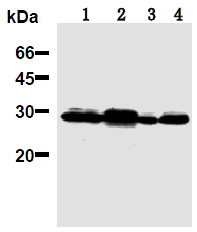
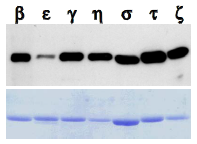
Specifications
| Product Data | |
| Clone Name | 3C8 |
| Applications | WB |
| Recommended Dilution | Western blot: 1-5 μg/ml for chemiluminescence detection system; for details see protocol below. |
| Reactivities | Human, Mouse, Rat |
| Host | Mouse |
| Isotype | IgG2b |
| Clonality | Monoclonal |
| Immunogen | Recombinant human 14-3-3β |
| Specificity | This antibody reacts with 14-3-3. |
| Formulation | PBS containing 50% glycerol, pH 7.2, containing no preservatives State: Azide Free State: Liquid Ig fraction |
| Concentration | 1.0 mg/ml |
| Purification | Protein A agarose |
| Background | 14-3-3 was first described as an abundant acidic protein in brain composing 1% of the total soluble protein. The 14-3-3 family of proteins are expressed in all eukaryotic cells. There are at least seven highly conserved isoforms encoded by different gene products. These proteins have molecular weights of 29,000–32,000 and bind numerous cytoplasmic and nuclear signaling molecules including signaling molecules such as Raf, protein kinase C, p130Cas, BAD, and phosphatidylinositol 3-kinase. Interaction of 14-3-3 proteins with signaling molecules can localize, activate, inhibit, or stabilize the target molecules. Because 14-3-3 proteins are homo- and heterodimers, they have been considered as adaptor proteins that recruit and regulate the function of signaling molecules. They have been implicated in regulation of cell proliferation, cell cycle progression, apoptosis, and differentiation. |
| Note | This product was originally produced by MBL International. Protocol: SDS-PAGE & Western Blotting |
| Reference Data | |
Documents
| Product Manuals |
| FAQs |
| SDS |
{0} Product Review(s)
Be the first one to submit a review