Acinus (ACIN1) (AcinusL) (N-term) Mouse Monoclonal Antibody [Clone ID: 3H8]

CAT#: AM26695AF-N

Acinus (ACIN1) (AcinusL) (N-term) mouse monoclonal antibody, clone 3H8, Azide Free


Size
    • 100 ug

Product Images

Specifications

Product Data
Clone Name 3H8
Applications IP, WB
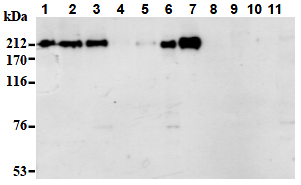
Recommended Dilution Western blot: 1 μg/ml for chemiluminescence detection system.
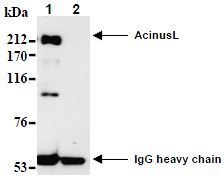
Immunoprecipitation: 2 μg / 200 μL of cell extract from  5x10⁶ cells.
Reactivities Human
Host Mouse
Isotype IgG1
Clonality Monoclonal
Immunogen GST-human AcinusL fusion protein corresponding to N-terminal amino acids (1~523 a.a.)
Specificity

This antibody reacts withAcinusL.

Formulation PBS containing 50% glycerol, pH 7.2. Contains no preservatives.
State: Azide Free
State: Liquid Ig fraction
Concentration 1.0 mg/ml
Purification Protein A agarose beads
Predicted Protein Size 220 kDa
Background Chromatin condensation and nuclear fragmentation (CCNF) are hallmarks of apoptosis. CCNF is triggered by the activation of members of the caspase family, caspase-activated DNase (CAD/DFF40) and several novel proteins including AIF and CIDE. A new inducer of chromatin condensation was recently identified and designated Acinus (Apoptotic Chromatin Condensation Inducer in the Nucleus). The 220 kDa Acinus protein is cleaved by caspase-3 and an additional unknown protease to generate a 17 kDa peptide that which causes chromatin condensation in vitro when added to purified nuclei. Acinus also induces apoptotic chromatin condensation in cells. Three different spliced forms of Acinus have been identified in human and mouse and designated AcinusL, AcinusS, and AcinusS'. Acinus is ubiquitously expressed.
Synonyms KIAA0670
Note This product was originally produced by MBL International.

Protocol:

SDS-PAGE & Western Blotting
1) Wash the cells 3 times with PBS and suspend with 10 volumes of cold Lysis buffer (50 mM Tris-HCl, pH 7.2, 250 mM NaCl, 0.1% NP-40, 2 mM EDTA, 10% glycerol) containing appropriate protease inhibitors. Incubate it at 4 oC with rotating for 30 minutes, then sonicate briefly (up to 10 seconds).
2) Centrifuge the tube at 12,000 x g for 10 minutes at 4 oC and transfer the supernatant to another tube. Measure the protein concentration of the supernatant and add the cold Lysis buffer to make an 8 mg/mL solution.
3) Mix the sample with equal volume of Laemmli’s sample buffer.
4) Boil the samples for 2 minutes and centrifuge. Load 10 µL of the sample per lane in a 1 mm thick SDS-polyacrylamide gel for electrophoresis.
5) Blot the protein to a polyvinylidene difluoride (PVDF) membrane at 1 mA/cm2 for 1 hour in a semi-dry transfer system (Transfer Buffer: 25 mM Tris, 190 mM glycine, 20% MeOH). See the manufacture's manual for specific transfer procedure.
6) To reduce nonspecific binding, soak the membrane in 10% skimmed milk (in PBS, pH 7.2) for 1 hour at room temperature, or overnight at 4 oC.
7) Incubate the membrane with primary antibody diluted with PBS, pH 7.2 containing 1% skimmed milk as suggested in the APPLICATIONS for 1 hour at room temperature. (The optimal antibody concentration will depend on the experimental conditions.)
8) Wash the membrane with PBS (5 minutes x 6 times).
9) Incubate the membrane with the 1:10,000 POD-conjugated anti-mouse IgG diluted with 1% skimmed milk (in PBS, pH 7.2) for 1 hour at room temperature.
10) Wash the membrane with PBS (5 minutes x 6 times).
11) Wipe excess buffer from the membrane, then incubate it with appropriate chemiluminescence reagents for 1 minute. Remove extra reagent from the membrane by dabbing with a paper towel, and seal it in plastic wrap.
12) Expose to X-ray film in a dark room for 5 minutes. Develop the film as usual. The conditions for exposure and development may vary.
Positive control for Western blotting; Jurkat, Raji, HeLa, A431

Immunoprecipitation
1) Wash the cells 3 times with PBS and suspend with 10 volumes of cold Lysis buffer (50 mM Tris-HCl pH 7.2, 250 mM NaCl, 0.1% NP-40, 2 mM EDTA, 10% glycerol) containing appropriate protease inhibitors. Incubate it at 4 oC with rotating for 30 minutes, then sonicate briefly (up to 10 seconds)
2) Centrifuge the tube at 12,000 x g for 10 minutes at 4 oC and transfer the supernatant to another tube.
3) Add primary antibody as suggested in the APPLICATIONS into 200 µL of the supernatant. Mix well and incubate with gentle agitation for 30-120 minutes at 4 oC. Add 20 µL of 50% protein A agarose beads resuspended in the cold Lysis buffer. Mix well and incubate with gentle agitation for 60 minutes at 4 oC.
4) Wash the beads 3-5 times with the cold Lysis buffer (centrifuge the tube at 2,500 x g for 10 seconds).
5) Resuspend the beads in 20 µL of Laemmli’s sample buffer, boil for 3-5 minutes, and centrifuge for 5 minutes. Use 10 µL/lane for the SDS-PAGE analysis. (See SDS-PAGE & Western blotting.)
Positive control for Immunoprecipitation; A431

Reference Data

{0} Product Review(s)

0 Product Review(s) Submit review

Be the first one to submit a review

Product Citations

*Delivery time may vary from web posted schedule. Occasional delays may occur due to unforeseen complexities in the preparation of your product. International customers may expect an additional 1-2 weeks in shipping.