



 Germany
 Japan
Japan
 United Kingdom
 China
China
AF9 (MLLT3) (C-term) Rabbit Polyclonal Antibody
Product Images
Other products for "MLLT3"
Specifications
| Product Data | |
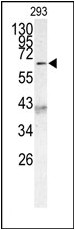
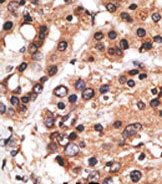
| Applications | IHC, WB |
| Recommended Dilution | ELISA: 1/1,000 (peptide only) Western Blot: 1/1000. Immunohistochemistry on Paraffin Sections: 1/50-1/100. |
| Reactivities | Human |
| Host | Rabbit |
| Isotype | Ig |
| Clonality | Polyclonal |
| Immunogen | KLH conjugated synthetic peptide between 471-502 amino acid from the C-terminal region of Human MLLT3. |
| Specificity | This antibody reacts to AF9 (MLLT3). |
| Formulation | PBS State: Purified State: Liquid purified Ig fraction Preservative: 0.09% (W/V) Sodium Azide |
| Concentration | lot specific |
| Purification | Protein G column, eluted with high and low pH buffers and neutralized immediately, followed by dialysis against PBS |
| Conjugation | Unconjugated |
| Storage | Store undiluted at 2-8°C for one month or (in aliquots) at -20°C for longer. Avoid repeated freezing and thawing. |
| Stability | Shelf life: one year from despatch. |
| Predicted Protein Size | 63351 Da |
| Gene Name | myeloid/lymphoid or mixed-lineage leukemia; translocated to, 3 |
| Database Link | |
| Background | The human AF9 gene is one of the most common fusion partner genes with the ALL1 gene at 11q23 (also called MLL), resulting in the t(9;11)(p22;q23). The AF9 gene is more than 100 kb, and 2 patient breakpoint cluster regions (BCRs) have been identified; BCR1 is within intron 4, previously called site A, whereas BCR2 or site B spans introns 7 and 8. Several different structural elements have been identified in AF9, including a colocalizing in vivo DNA topo II cleavage site and an in vitro DNase I hypersensitive (DNase 1 HS) site in intron 7 in BCR2. Reversibility experiments demonstrated a religation of the topo II cleavage sites. In addition, 2 scaffold associated regions (SARs) are located centromeric to the topo II and DNase I HS cleavage sites and border breakpoint regions in 2 leukemic cells lines: SAR1 is located in intron 4, whereas SAR2 encompasses parts of exons 5-7. The patient breakpoint regions of AF9 share the same structural elements as the MLL BCR. A DNA breakage and repair model for nonhomologous recombination between MLL and its partner genes, particularly AF9, has been proposed. |
| Synonyms | YEATS3, Protein AF-9 |
| Reference Data | |
Documents
| Product Manuals |
| FAQs |
| SDS |
{0} Product Review(s)
0 Product Review(s)
Submit review
Be the first one to submit a review



Product Citations
*Delivery time may vary from web posted schedule. Occasional delays may occur due to unforeseen
complexities in the preparation of your product. International customers may expect an additional 1-2 weeks
in shipping.