



 Germany
 Japan
Japan
 United Kingdom
 China
China
PGK1 (Center) Rabbit Polyclonal Antibody
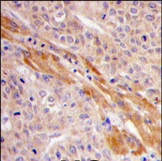
Product Images

Specifications
| Product Data | |
| Clone Name | RB5517 |
| Applications | IHC, WB |
| Recommended Dilution | WB 1:1000 IHC-P 1:10~50 |
| Reactivities | Human |
| Host | Rabbit |
| Isotype | IgG |
| Clonality | Polyclonal |
| Immunogen | This antibody is generated from rabbits immunized with a KLH conjugated synthetic peptide selected from the Center region of human PGK1. |
| Specificity | This PGK1 antibody is generated from rabbits immunized with a KLH conjugated synthetic peptide between 305-334 amino acids from the Central region of human PGK1. |
| Formulation | PBS with 0.09% (W/V) sodium azide State: Purified State: Liquid purified Ig |
| Concentration | lot specific |
| Purification | Purified polyclonal antibody supplied in PBS with 0.09% (W/V) sodium azide. This antibody is prepared by Saturated Ammonium Sulfate (SAS) precipitation followed by dialysis against PBS. |
| Conjugation | Unconjugated |
| Storage | Store the antibody undiluted at 2-8°C for one month or (in aliquots) at -20°C for longer. Avoid repeated freezing and thawing. |
| Stability | Shelf life: one year from despatch. |
| Predicted Protein Size | 44615 kDa |
| Gene Name | phosphoglycerate kinase 1 |
| Database Link | |
| Background | Also known as ATP:3-phosphoglycerate 1-phosphotransferase, this major enzyme in glycolysis catalyzes the reversible conversion of 1,3-diphosphoglycerate to 3-phosphoglycerate, generating one molecule of ATP. Phosphoglycerate kinase not only functions in glycolysis but is secreted by tumor cells and is proposed to participate in the angiogenic process as a disulfide reductase. Mutations in PGK1 may be associated with hemolytic anemia. |
| Synonyms | PGKA, PRP 2 |
| Reference Data | |
Documents
| Product Manuals |
| FAQs |
| SDS |
{0} Product Review(s)
0 Product Review(s)
Submit review
Be the first one to submit a review



Product Citations
*Delivery time may vary from web posted schedule. Occasional delays may occur due to unforeseen
complexities in the preparation of your product. International customers may expect an additional 1-2 weeks
in shipping.