



 Germany
 Japan
Japan
 United Kingdom
 China
China
CD4 Rabbit Polyclonal Antibody
Product Images
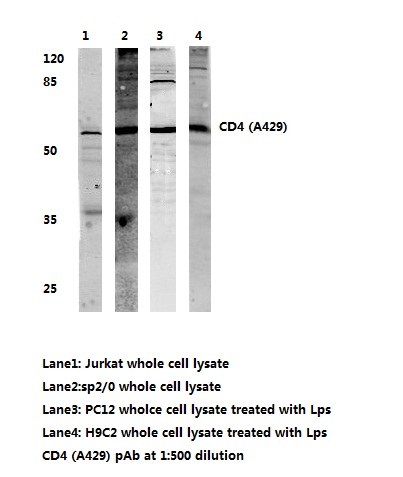
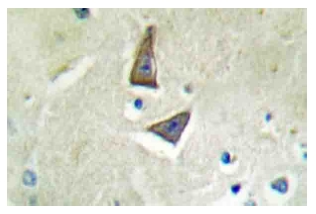
Other products for "CD4"
Specifications
| Product Data | |
| Applications | IF, IHC, WB |
| Recommended Dilution | Western blot: 1/500-1/1000. Immunofluorescence: 1/50-1/200. Immunohistochemistry on Paraffin Sections: 1/50-1/200. |
| Reactivities | Human, Mouse |
| Host | Rabbit |
| Clonality | Polyclonal |
| Immunogen | Synthetic peptide corresponding to amino acids 391-440 of Human CD4. |
| Specificity | This antibody antibody detects endogenous levels of CD4 protein (region surrounding Ala429). |
| Formulation | Phosphate buffered saline (PBS), pH~7.2 State: Aff - Purified State: Liquid purified Ig fraction (> 95% pure by SDS-PAGE) Preservative: 0.05% Sodium Azide |
| Concentration | 1.0 mg/ml |
| Purification | Affinity Chromatography using epitope-specific immunogen |
| Predicted Protein Size | ~ 51 kDa |
| Gene Name | Homo sapiens CD4 molecule (CD4), transcript variant 1 |
| Database Link | |
| Background | Cluster of Differentiation 4 (CD4) is a glycoprotein composed of an amino-terminal extracellular domain (four domains: D1-D4 with Ig-like structures), a transmembrane part and a short cytoplasmic tail. CD4 is expressed on the surface of T helper cells, regulatory T cells, monocytes, macrophages and dendritic cells, and plays an important role in the development and activation of T cells. On T cells, CD4 is the co-receptor for the T cell receptor (TCR), and these two distinct structures recognize the Antigen–Major Histocompatibility Complex (MHC). Specifically, the D1 domain of CD4 interacts with the ?2-domain of the MHC class II molecule. CD4 ensures specificity of the TCR–antigen interaction, prolongs the contact between the T cell and the antigen presenting cell and recruits the tyrosine kinase Lck, which is essential for T cell activation. |
| Synonyms | T-cell surface antigen T4/Leu-3 |
| Reference Data | |
| Protein Families | Adult stem cells, Druggable Genome, ES Cell Differentiation/IPS, Induced pluripotent stem cells, Transmembrane |
| Protein Pathways | Antigen processing and presentation, Cell adhesion molecules (CAMs), Hematopoietic cell lineage, Primary immunodeficiency, T cell receptor signaling pathway |
Documents
| Product Manuals |
| FAQs |
| SDS |
{0} Product Review(s)
0 Product Review(s)
Submit review
Be the first one to submit a review



Product Citations
*Delivery time may vary from web posted schedule. Occasional delays may occur due to unforeseen
complexities in the preparation of your product. International customers may expect an additional 1-2 weeks
in shipping.