



 Germany
 Japan
Japan
 United Kingdom
 China
China
HSP90AA1 Rabbit Monoclonal Antibody [Clone ID: EPNCIR102]
Product Images
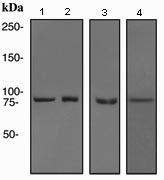
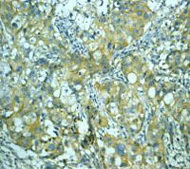
Other products for "HSP90AA1"
Specifications
| Product Data | |
| Clone Name | EPNCIR102 |
| Applications | IHC, WB |
| Recommended Dilution | WB: 1:1000 - 1:10000; IHC-P: 1:50 - 1:100 |
| Reactivities | Human, Mouse, Rat |
| Host | Rabbit |
| Isotype | IgG |
| Clonality | Monoclonal |
| Immunogen | A synthetic peptide corresponding to residues in human Hsp90 Alpha was used as an immunogen. |
| Formulation | PBS 49%,Sodium azide 0.01%,Glycerol 50%,BSA 0.05% |
| Purification | Tissue culture supernatant |
| Conjugation | Unconjugated |
| Storage | Store at -20°C as received. |
| Stability | Stable for 12 months from date of receipt. |
| Predicted Protein Size | 85 kDa |
| Gene Name | heat shock protein 90kDa alpha family class A member 1 |
| Database Link | |
| Background | Heat shock protein 90 alpha (Hsp90 alpha) is a cytosolic homodimeric molecular chaperone that modulates the stability and/or transport of a diverse set of critical cellular regulatory, metabolism, organization, and signaling proteins (1). Hsp90 distinguishes itself from other chaperones by having most of its known substrates as signal transduction proteins; e.g. non activated steroid hormone receptors, several proto-oncogenic tyrosine and serine/threonine kinases, and actin (2). These substrates are brought into complex by a multiprotein hsp90/hsp70-based chaperone machinery to function in protein folding (3). Two isoforms correspond to the major and minor isoform, Hsp90 alpha and Hsp90 beta. Hsp90 beta is expressed constitutively to a high level in most tissues and is generally more abundant than Hsp90 alpha, whereas Hsp90 alpha is stress-inducible and overexpressed in many cancer cells (4). |
| Synonyms | EL52; HSP86; Hsp89; HSP89A; Hsp90; HSP90A; HSP90N; HSPC1; HSPCA; HSPCAL1; HSPCAL4; HSPN; LAP-2; LAP2 |
| Note | Is unsuitable for Flow Cyt,ICC or IP. |
| Reference Data | |
| Protein Families | Druggable Genome |
| Protein Pathways | Antigen processing and presentation, NOD-like receptor signaling pathway, Pathways in cancer, Progesterone-mediated oocyte maturation, Prostate cancer |
Documents
| Product Manuals |
| FAQs |
{0} Product Review(s)
0 Product Review(s)
Submit review
Be the first one to submit a review



Product Citations
*Delivery time may vary from web posted schedule. Occasional delays may occur due to unforeseen
complexities in the preparation of your product. International customers may expect an additional 1-2 weeks
in shipping.