



 Germany
 Japan
Japan
 United Kingdom
 China
China
CD19 Rabbit Polyclonal Antibody
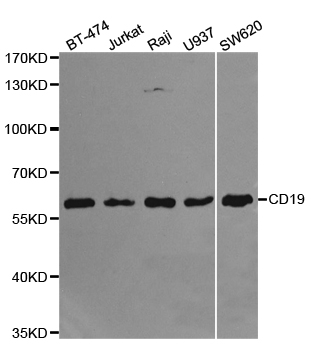
Product Images
Frequently bought together (3)
Transient overexpression lysate of CD19 molecule (CD19)
USD 436.00
Other products for "CD19"
Specifications
| Product Data | |
| Applications | ELISA, ICC/IF, WB |
| Recommended Dilution | WB,1:500 - 1:1000 IF/ICC,1:50 - 1:200 ELISA,Recommended starting concentration is 1 μg/mL. Please optimize the concentration based on your specific assay requirements. |
| Reactivities | Human, Mouse, Rat |
| Host | Rabbit |
| Isotype | IgG |
| Clonality | Polyclonal |
| Formulation | Buffer: PBS with 0.02% sodium azide,50% glycerol,pH7.3. |
| Concentration | lot specific |
| Purification | Affinity purification |
| Conjugation | Unconjugated |
| Storage | Store at -20℃. Avoid freeze / thaw cycles. |
| Stability | Stable for 12 months from date of receipt. |
| Predicted Protein Size | 61kDa |
| Gene Name | CD19 molecule |
| Database Link | |
| Background | This gene encodes a member of the immunoglobulin gene superfamily. Expression of this cell surface protein is restricted to B cell lymphocytes. This protein is a reliable marker for pre-B cells but its expression diminishes during terminal B cell differentiation in antibody secreting plasma cells. The protein has two N-terminal extracellular Ig-like domains separated by a non-Ig-like domain, a hydrophobic transmembrane domain, and a large C-terminal cytoplasmic domain. This protein forms a complex with several membrane proteins including complement receptor type 2 (CD21) and tetraspanin (CD81) and this complex reduces the threshold for antigen-initiated B cell activation. Activation of this B-cell antigen receptor complex activates the phosphatidylinositol 3-kinase signalling pathway and the subsequent release of intracellular stores of calcium ions. This protein is a target of chimeric antigen receptor (CAR) T-cells used in the treatment of lymphoblastic leukemia. Mutations in this gene are associated with the disease common variable immunodeficiency 3 (CVID3) which results in a failure of B-cell differentiation and impaired secretion of immunoglobulins. CVID3 is characterized by hypogammaglobulinemia, an inability to mount an antibody response to antigen, and recurrent bacterial infections. Alternative splicing results in multiple transcript variants encoding distinct isoforms. |
| Synonyms | B4; CVID3 |
| Reference Data | |
| Protein Families | Druggable Genome, Transmembrane |
| Protein Pathways | B cell receptor signaling pathway, Hematopoietic cell lineage, Primary immunodeficiency |
Documents
| Product Manuals |
| FAQs |
| SDS |
{0} Product Review(s)
0 Product Review(s)
Submit review
Be the first one to submit a review



Product Citations
*Delivery time may vary from web posted schedule. Occasional delays may occur due to unforeseen
complexities in the preparation of your product. International customers may expect an additional 1-2 weeks
in shipping.