



 Germany
 Japan
Japan
 United Kingdom
 China
China
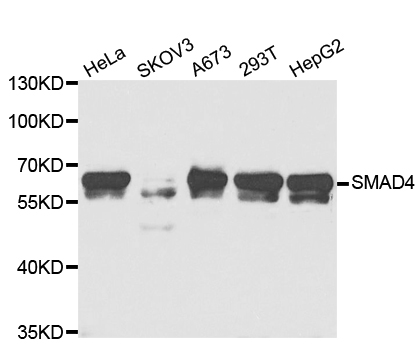
SMAD4 Rabbit Polyclonal Antibody
Product Images

Frequently bought together (3)
Transient overexpression lysate of SMAD family member 4 (SMAD4)
USD 436.00
Other products for "SMAD4"
Specifications
| Product Data | |
| Applications | ELISA, ICC/IF, IHC, WB |
| Recommended Dilution | WB,1:500 - 1:2000 IHC-P,1:50 - 1:200 IF/ICC,1:50 - 1:200 ELISA,Recommended starting concentration is 1 μg/mL. Please optimize the concentration based on your specific assay requirements. |
| Reactivities | Human, Mouse, Rat |
| Host | Rabbit |
| Isotype | IgG |
| Clonality | Polyclonal |
| Formulation | Buffer: PBS with 0.05% proclin300,50% glycerol,pH7.3. |
| Concentration | lot specific |
| Purification | Affinity purification |
| Conjugation | Unconjugated |
| Storage | Store at -20℃. Avoid freeze / thaw cycles. |
| Stability | Stable for 12 months from date of receipt. |
| Predicted Protein Size | 60kDa |
| Gene Name | SMAD family member 4 |
| Database Link | |
| Background | This gene encodes a member of the Smad family of signal transduction proteins. Smad proteins are phosphorylated and activated by transmembrane serine-threonine receptor kinases in response to transforming growth factor (TGF)-beta signaling. The product of this gene forms homomeric complexes and heteromeric complexes with other activated Smad proteins, which then accumulate in the nucleus and regulate the transcription of target genes. This protein binds to DNA and recognizes an 8-bp palindromic sequence (GTCTAGAC) called the Smad-binding element (SBE). The protein acts as a tumor suppressor and inhibits epithelial cell proliferation. It may also have an inhibitory effect on tumors by reducing angiogenesis and increasing blood vessel hyperpermeability. The encoded protein is a crucial component of the bone morphogenetic protein signaling pathway. The Smad proteins are subject to complex regulation by post-translational modifications. Mutations or deletions in this gene have been shown to result in pancreatic cancer, juvenile polyposis syndrome, and hereditary hemorrhagic telangiectasia syndrome. |
| Synonyms | DPC4; JIP; MADH4; MYHRS |
| Reference Data | |
| Protein Families | Druggable Genome, Transcription Factors |
| Protein Pathways | Adherens junction, Cell cycle, Chronic myeloid leukemia, Colorectal cancer, Pancreatic cancer, Pathways in cancer, TGF-beta signaling pathway, Wnt signaling pathway |
Documents
| Product Manuals |
| FAQs |
| SDS |
{0} Product Review(s)
0 Product Review(s)
Submit review
Be the first one to submit a review


Product Citations
*Delivery time may vary from web posted schedule. Occasional delays may occur due to unforeseen
complexities in the preparation of your product. International customers may expect an additional 1-2 weeks
in shipping.