



 Germany
 Japan
Japan
 United Kingdom
 China
China
MADH7 (SMAD7) Rabbit Polyclonal Antibody
Product Images
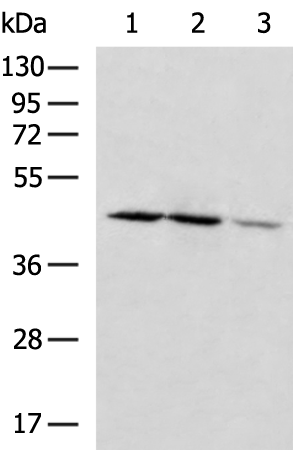
Other products for "SMAD7"
Specifications
| Product Data | |
| Applications | WB |
| Recommended Dilution | WB: 500-2000 WB positive control: Mouse heart tissue, SKOV3 cell, Mouse liver tissue lysates |
| Reactivities | Human, Mouse, Rat |
| Host | Rabbit |
| Isotype | IgG |
| Clonality | Polyclonal |
| Immunogen | Synthetic peptide of human SMAD7 |
| Formulation | pH7.4 PBS, 0.05% NaN3, 40% Glycerol |
| Concentration | lot specific |
| Purification | Antigen affinity purification |
| Conjugation | Unconjugated |
| Storage | Store at -20°C. |
| Stability | 1 year |
| Predicted Protein Size | 46 kDa |
| Gene Name | SMAD family member 7 |
| Database Link | |
| Background | The protein encoded by this gene is a nuclear protein that binds the E3 ubiquitin ligase SMURF2. Upon binding, this complex translocates to the cytoplasm, where it interacts with TGF-beta receptor type-1 (TGFBR1), leading to the degradation of both the encoded protein and TGFBR1. Expression of this gene is induced by TGFBR1. Variations in this gene are a cause of susceptibility to colorectal cancer type 3 (CRCS3). Several transcript variants encoding different isoforms have been found for this gene. |
| Synonyms | CRCS3; FLJ16482; hSMAD7; MADH7; MADH8 |
| Reference Data | |
Documents
| Product Manuals |
| FAQs |
| SDS |
{0} Product Review(s)
0 Product Review(s)
Submit review
Be the first one to submit a review



Product Citations
*Delivery time may vary from web posted schedule. Occasional delays may occur due to unforeseen
complexities in the preparation of your product. International customers may expect an additional 1-2 weeks
in shipping.