


 Germany
 Japan
Japan
 United Kingdom
 China
China
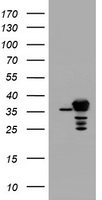
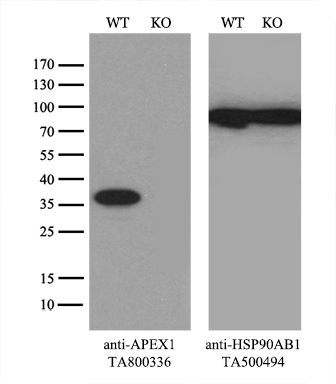
APE1 (APEX1) Mouse Monoclonal Antibody [Clone ID: OTI4D9]

Product Images


USD 823.00
USD 396.00
Specifications
| Product Data | |
| Clone Name | OTI4D9 |
| Applications | IHC, WB |
| Recommended Dilution | WB 1:2000, IHC 1:150 |
| Reactivities | Human, Dog, Rat, Monkey, Mouse |
| Host | Mouse |
| Isotype | IgG2b |
| Clonality | Monoclonal |
| Immunogen | Human recombinant protein fragment corresponding to amino acids 1-242 of human APEX1 (NP_001632) produced in E.coli. |
| Formulation | PBS (pH 7.3) containing 1% BSA, 50% glycerol and 0.02% sodium azide. |
| Concentration | 1 mg/ml |
| Purification | Purified from mouse ascites fluids or tissue culture supernatant by affinity chromatography (protein A/G) |
| Conjugation | Unconjugated |
| Storage | Store at -20°C as received. |
| Stability | Stable for 12 months from date of receipt. |
| Predicted Protein Size | 35.4 kDa |
| Gene Name | apurinic/apyrimidinic endodeoxyribonuclease 1 |
| Database Link | |
| Background | Apurinic/apyrimidinic (AP) sites occur frequently in DNA molecules by spontaneous hydrolysis, by DNA damaging agents or by DNA glycosylases that remove specific abnormal bases. AP sites are pre-mutagenic lesions that can prevent normal DNA replication so the cell contains systems to identify and repair such sites. Class II AP endonucleases cleave the phosphodiester backbone 5' to the AP site. This gene encodes the major AP endonuclease in human cells. Splice variants have been found for this gene; all encode the same protein. [provided by RefSeq, Jul 2008] |
| Synonyms | APE; APE1; APEN; APEX; APX; HAP1; REF1 |
| Reference Data | |
| Protein Families | Druggable Genome, Stem cell - Pluripotency, Transcription Factors |
| Protein Pathways | Base excision repair |
Documents
| Product Manuals |
| FAQs |
| SDS |
Resources
| Antibody Resources |
{0} Product Review(s)


APEX1 Monoclonal Antibody (OTI4D9), TrueMAB:
For our fusion protein: Poor signal, but we can't find any anti-APE1 that works with our fusion protein. We compared with Invitrogen MA-1440 and the Invitrogen had a little bit better signal at 10min exposure.
For endogenous protein: good signal. But had to do 600 second exposure for Origene, compared to 100 second for MA-1440.
Dan I. for TA800336 on 11/28/2023